Starting the Next Chapter: Advanced & CW

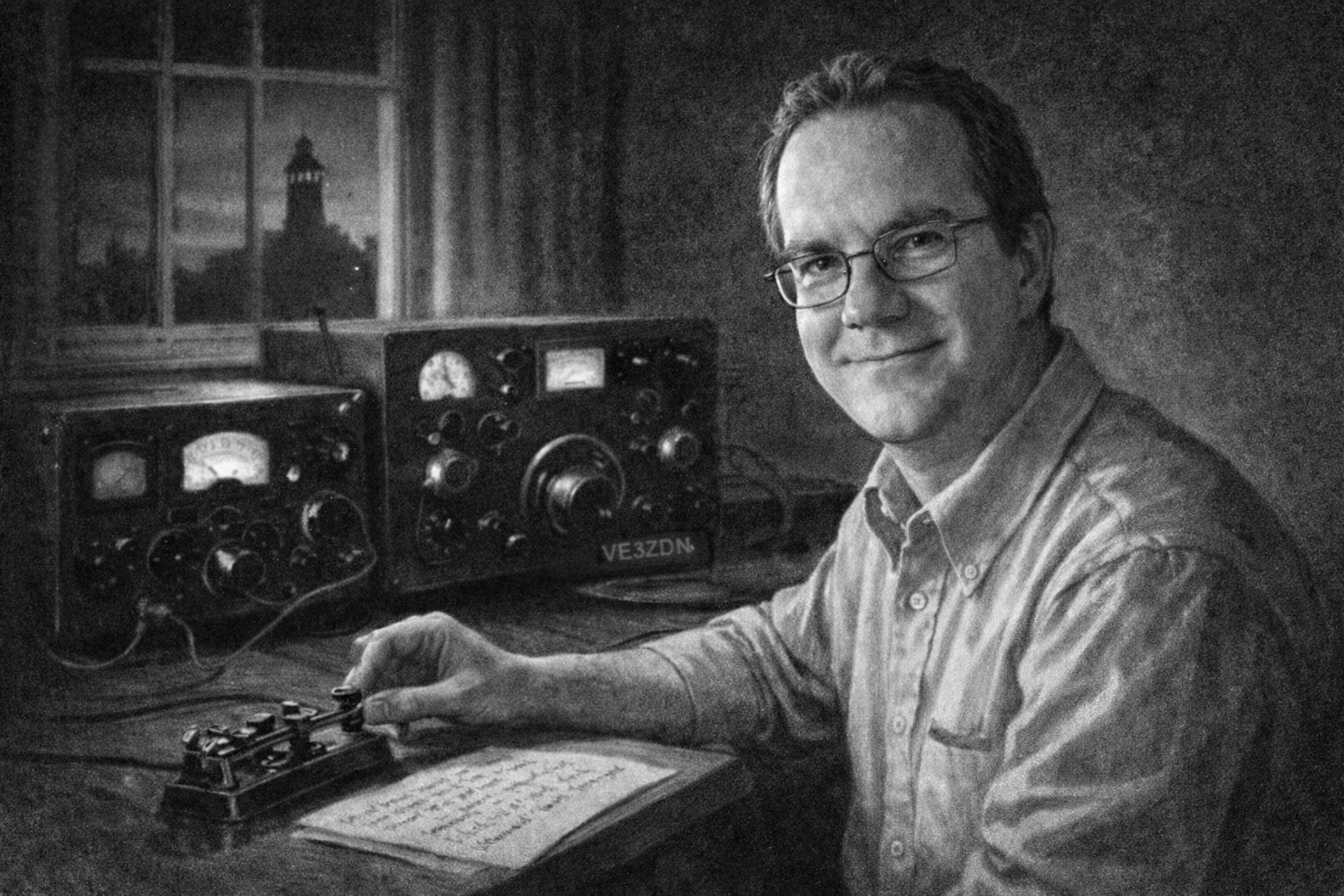
A black-and-white, 1940s-style illustration of Doug seated at a vintage radio operating desk. He’s smiling toward the viewer while one hand rests on a classic Morse code straight key. Behind him, retro radio equipment with glowing analog dials fills the scene, and through the window a distant tower is silhouetted against the night sky. The image evokes the atmosphere of an old-school radio shack and the focused calm of practicing CW.

Last updated on 2025-12-23 at 13:19 EST (UTC-05:00)
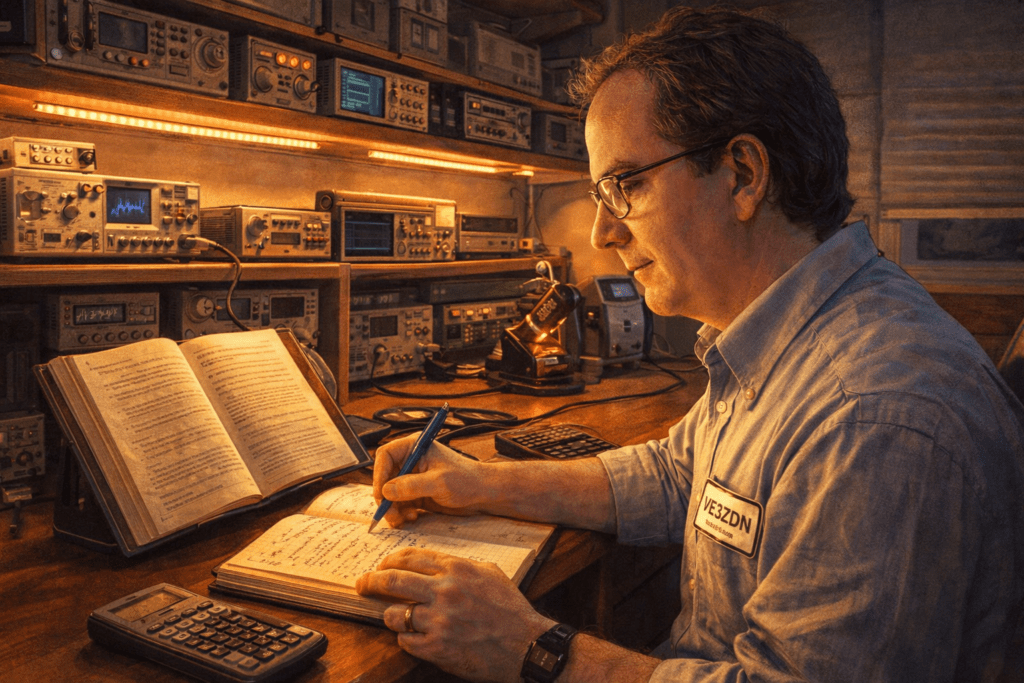
A warm, colour illustration of Doug seated at a workbench, studying for the Advanced Amateur Radio Certificate. He’s shown in profile, writing notes in an open hardbound notebook while a textbook sits propped up in front of him. Shelves packed with electronic test equipment—oscilloscopes, frequency counters, signal generators, and meters—fill the background, illuminated by an LED strip light overhead. A modern soldering station sits to his right, and a scientific calculator rests near his hand, creating the feel of a focused, well-equipped electronics workspace.
Hitting the books

I’ve officially cracked open the books again—this time for the Advanced Amateur Radio Certificate and the CW (Morse code) endorsement. It feels a bit like coming full circle: the kid who once tinkered with circuits and devoured electronics and radio magazines is now diving deeper into the theory, the math, and the hands-on craft that make amateur radio such a fascinating technical pursuit.

Hear my call sign, courtesy of Doug VE3XDB.

The Advanced material opens up everything I love: RF design, linearity, oscillators, filters, EMC, antennas, digital modes, and all the elegant physics that sit just beneath the surface of ordinary voice communication. It’s like pulling back the curtain on how radios really work—something I’ve spent my entire engineering career orbiting around anyway.

And CW? Well, that’s its own kind of magic. Learning Morse isn’t just memorizing dits and dahs; it’s learning to think in rhythm, timing, and sound patterns. It’s equal parts language, music, and meditation. There’s something charmingly old-school about connecting to over a century of radio history, while knowing that the skill is still as relevant today as it ever was. It’s where telecommunications began when Samuel Morse tapped out his first message on May 24th, 1844.
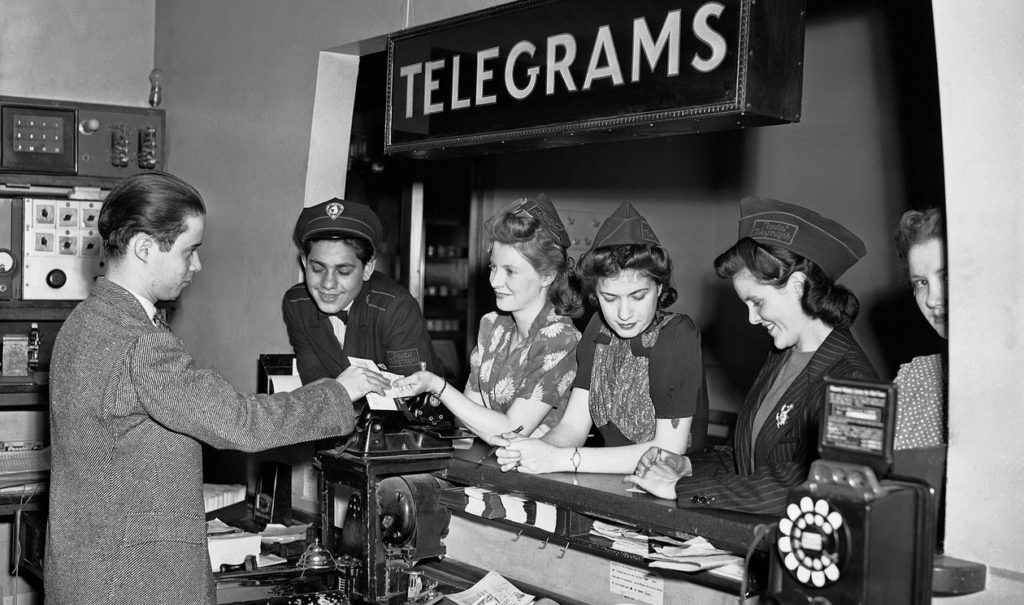
A 1942 black-and-white Associated Press photograph showing a young man handing a message across a counter at a Western Union telegram office. Behind the counter, four women and one male employee—dressed in wartime-era uniforms and patterned dresses—process telegrams and interact with customers. A large “TELEGRAMS” sign hangs overhead, and vintage communication equipment and a rotary telephone frame the busy, high-energy scene typical of World War II-era message centers.
In 1942, with the world deep in the turmoil of the Second World War, telegrams were still one of the fastest and most reliable ways to send important messages. Long before email or mobile phones, a telegram could deliver news across countries in minutes, which made it an essential tool for governments, the military, and families trying to stay connected during uncertain times.
AP Photo

Honestly, it feels good to be a student again. To stretch the brain. To wrestle with old and new ideas. To learn a skill that rewards both precision and patience.

Let’s see where this next leg of the journey leads.

— Doug (VE3ZDN)

Comments

Leave a Reply

Your email address will not be published. Required fields are marked *

This site uses Akismet to reduce spam. Learn how your comment data is processed.