You’re probably wondering, “Wait, what happened to Week 1 of CW class?” The short answer: I missed it. So, no post about Week 1. However, I will tell you about Week 2 😀.
I’m studying CW with Vic DeCicco (VE3YT). Vic teaches the KWARC course. The amazing thing is that KWARC offers the course for free!
In the first week of the course, Vic taught the first four letters of the Morse alphabet:
| Alpha Character | Morse |
| T | — |
| E | · |
| A | · — |
| N | — · |
The rationale, as I understand it anyway, is that the first two are the simplest code characters to learn, and the second two are combinations of the first two.
Learning Morse code is neurologically similar in several important respects to learning and decoding a language [1]–[4]. For a young person, this may be easier than for someone in their 60s because the brain’s capacity for rapid neuroplastic change generally declines with age. That does not mean that learning a new language—or learning Morse code—is impossible in your 60s; it may simply require more time and practice.
There may even be a cognitive side benefit. Studies of bilingualism and later-life cognition suggest that lifelong use of more than one language may contribute to cognitive reserve and has been associated with a later onset of dementia symptoms, although the evidence does not clearly show that bilingualism reduces the overall risk of developing dementia [5]–[7]. So there’s that.
Ok, so back to learning to “head copy” Morse Code. So far, I’ve found I sometimes have difficulty with the compound codes. It’s first a case of distinguishing the dits from the dahs, and then making the correct association. That’s why I’m practicing as much as I can.
During the class, Vic briefly reviewed the first four letters, and then introduced a few more:
| Alpha Character | Morse |
| New paragraph (also =) (BT) | — · · · — |
| Hyphen | — · · · · — |
| Error | · · · · · · · · (8 dits) |
| O | ——— |
| I | · · |
| R | · — · |
| S | · · · |
| M | — — |
After all that, he started sending short sentences constructed with the characters we were learning. I did OK at first, but my ear (more likely my brain) fatigued quickly, leaving me unable to copy most of the sentences. I got occasional letters right, but not enough to form coherent messages.
I’m using a trainer written by one of the guys in our club, Nick VA3NNW, Nosey Nick’s Nilex Morse Code Trainer.

The trainer uses the Koch method to teach increasingly difficult codes, using character repetition to help burn the connections between sounds and letters into my brain.
Since the letter order is the same as the order Vic’s using, that will help with consistency. The more I practice, the more firmly those audible patterns will be etched in, allowing me to hear a string of sounds and hear the words much like hearing them spoken on an SSB phone transmission. That is the essence of headcopying.
Vic also sent us some practice audio clips that I need to try copying. I’ve got some homework to do!
Understanding the Koch Method
The “Koch method” comes from Ludwig Koch’s 1936 doctoral work at the Technische Hochschule Braunschweig, published as Arbeitspsychologische Untersuchung der Tätigkeit bei der Aufnahme von Morsezeichen, zugleich ein neues Anlernverfahren für Funker — roughly, Occupational-psychological investigation of the activity of receiving Morse code, together with a new training method for radio operators. Long Island CW Club
Koch’s central argument was that Morse should be learned as an auditory Gestalt — a complete sound pattern — rather than as a sequence of dots and dashes. He explicitly compared Morse recognition with other forms of holistic perception, including recognizing melodies and reading words as wholes rather than consciously assembling their constituent parts. Long Island CW Club
That is the important bit. “Koch training” is not merely “add one letter at a time.”
What Koch actually proposed
His procedure essentially reverses the older method.
Instead of:
learn all the characters slowly → practise them → gradually increase speed
Koch proposed:
begin at a sufficiently high character speed → learn only a couple of characters → progressively add characters while keeping the speed essentially constant.
He wrote that training could begin with only two characters, practised until the learner could write them down automatically, with additional characters then introduced progressively. Long Island CW Club
He settled on a target training speed of 60 characters per minute. Koch considered this the optimum introductory speed because below roughly 50 characters/minute the learner could still analyze the individual elements; above that point the character increasingly becomes perceived as a single auditory shape. Long Island CW Club
In modern amateur-radio terms, 60 characters/minute under the usual PARIS convention is about 12 WPM.
That is rather interesting because Koch did not argue “the faster the better.” He experimented with 100 characters/minute as an initial speed and found it unnecessarily mentally demanding for ordinary learners as the character set grew. He therefore recommended 60 characters/minute as a practical optimum. Long Island CW Club
So the authentic Koch principle is closer to:
Start around 12 WPM, hear each character as a sound object, avoid consciously decoding dits and dahs, and gradually expand your vocabulary of sound patterns.
Something I hadn’t appreciated until looking at the original
The modern “Koch method” is actually a simplified descendant of Koch’s method.
Koch experimented with a two-pitch teaching technique in which dits and dahs were initially presented at slightly different pitches. His idea was to exaggerate the melodic or rhythmic shape of the character and then gradually bring the two pitches together until ordinary single-tone Morse remained. Long Island CW Club
You virtually never see that in modern Koch trainers.
He was therefore thinking much more explicitly in terms of auditory pattern formation than most descriptions of his method suggest.
He summarized his method near the end of the paper this way: the old methods taught all characters slowly and then raised the speed; his method began immediately at 60 characters/minute, initially with two characters, and progressively introduced the rest. Long Island CW Club
His training results were also respectable.
PARIS Convention
The PARIS convention is the standard way to define Morse-code speed in words per minute (WPM).
The problem is that real words vary wildly in length. So instead of using arbitrary English text, Morse speed is calibrated against the standard word:
PARIS
When sent in International Morse with normal spacing, PARIS contains exactly 50 timing units.
So:
1 WPM = 50 Morse timing units per minute
That gives the usual relationship:

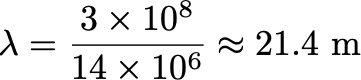
For example, at 20 WPM, one dit lasts:

A dah is three dits, so 180 ms; the intra-character gap is one dit; the character gap is three dits; and the word gap is seven dits.
This is why Koch’s 60 characters per minute only approximates 12 WPM.
Characters per minute and PARIS WPM aren’t exactly interchangeable unless you assume an average character length and spacing.
For amateur CW today, when someone says 20 WPM, they almost always mean PARIS.
Koch reported that learners mastered all letters at 60 characters/minute in approximately 24–28 hours of training. Long Island CW Club
I would treat that figure as a historical experimental result rather than a promise of what every learner should achieve.
Something I hadn’t appreciated until looking at the original
The modern “Koch method” is actually a simplified descendant of Koch’s method.
Koch experimented with a two-pitch teaching technique in which dits and dahs were initially presented at slightly different pitches. His idea was to exaggerate the character’s melodic or rhythmic shape and then gradually bring the two pitches together until ordinary single-tone Morse remained. Long Island CW Club
You virtually never see that in modern Koch trainers.
He was therefore thinking much more explicitly in terms of auditory pattern formation than most descriptions of his method suggest.
He summarized his method near the end of the paper this way: the old methods taught all characters slowly and then raised the speed; his method began immediately at 60 characters/minute, initially with two characters, and progressively introduced the rest. Long Island CW Club
What about the famous “90% accuracy, then add another character” rule?
This is where modern lore creeps in.
The typical present-day description says:
- learn two characters;
- copy random groups at target speed;
- reach about 90% accuracy;
- add another character;
- repeat.
That is a perfectly reasonable implementation, but the 90% threshold is not really the essence of Koch’s method, and it does not appear to be the famous explicit rule people sometimes imply it was. Koch talks instead about acquiring sufficient confidence or automaticity before expanding the set. His summary says the characters are added progressively while the receiving speed stays fixed. Long Island CW Club
So I’d distinguish the Koch principle from modern Koch software conventions.
Other trainers besides Nosey Nick’s
One master CW Operator, Ray Burlingame-Goff (G4FON/SK), wrote a CW trainer that you can still download from his website. It’s Windows only, so if you’re a Mac user, you would need to run it in a 32-bit emulation environment unless you’ve got a Windows machine hanging around. G4FON suggests in his 2018 B talk.
There are many more, of course:
- Learn CW Online
- Morsecode World‘s International Morse Code Academy
- Just Learn Morse Code
- K7QO’s Code Course
- K6RAU’s Code Course – SKCC Member #11992
I’m sure there are many more, and certainly more than I’ve tried.
Koch versus Farnsworth
These are often mixed together, but they solve different problems.
Koch controls vocabulary: only a few characters are initially available, but they are sent at realistic speed.
Farnsworth controls timing: individual characters are sent rapidly, but extra spacing is inserted between characters and words so the learner has time to recognize them.
They can be combined — and most modern CW trainers effectively do. You might hear characters at 18–20 WPM while the extra spacing gives an effective text speed of 8–10 WPM, and introduce characters progressively in Koch fashion.
Koch himself, though, was quite concerned about preserving the correct temporal character shape and avoiding the psychological “changeover” required when someone first learns unnaturally slow Morse and later tries to speed it up. Long Island CW Club
Morse behaves rather like language acquisition. Koch’s own theoretical explanation is strikingly similar: you want to hear
-.- → K
not
dah + dit + dah → K.
So… Onward. The class is on Wednesday, and I’m feeling horribly unprepared.
73 de Doug VE3ZDN
Refrences
[1] L. Schlaffke, A. Leemans, L. M. Schweizer, S. Ocklenburg, and T. Schmidt-Wilcke, “Learning Morse Code Alters Microstructural Properties in the Inferior Longitudinal Fasciculus: A DTI Study,” Frontiers in Human Neuroscience, vol. 11, p. 383, Jul. 2017, doi: 10.3389/fnhum.2017.00383. PubMed Central (PMC)
[2] F. B. Junker, L. Schlaffke, C. Bellebaum, M. Ghio, S. Brühl, N. Axmacher, and T. Schmidt-Wilcke, “Transition From Sublexical to Lexico-Semantic Stimulus Processing,” Frontiers in Systems Neuroscience, vol. 14, 2020, doi: 10.3389/fnsys.2020.522384. PubMed
[3] F. B. Junker, T. Schmidt-Wilcke, A. Schnitzler, and J. Lange, “Temporal dynamics of oscillatory activity during nonlexical language decoding: Evidence from Morse code and magnetoencephalography,” Human Brain Mapping, vol. 44, no. 17, pp. 6185–6197, 2023, doi: 10.1002/hbm.26505.
[4] F. B. Junker, L. Schlaffke, J. Lange, and T. Schmidt-Wilcke, “The angular gyrus serves as an interface between the non-lexical reading network and the semantic system: evidence from dynamic causal modeling,” Brain Struct Funct, vol. 229, no. 3, pp. 561–575, Mar. 2023, doi: 10.1007/s00429-023-02624-z.
[5] E. Bialystok, F. I. M. Craik, and M. Freedman, “Bilingualism as a protection against the onset of symptoms of dementia,” Neuropsychologia, vol. 45, no. 2, pp. 459–464, 2007, doi: 10.1016/j.neuropsychologia.2006.10.009. PubMed
[6] S. Alladi, T. H. Bak, V. Duggirala, B. Surampudi, M. Shailaja, A. K. Shukla, J. R. Chaudhuri, and S. Kaul, “Bilingualism delays age at onset of dementia, independent of education and immigration status,” Neurology, vol. 81, no. 22, pp. 1938–1944, 2013, doi: 10.1212/01.wnl.0000436620.33155.a4. PubMed
[7] N. Mukadam, A. Sommerlad, and G. Livingston, “The relationship of bilingualism compared to monolingualism to the risk of cognitive decline or dementia: A systematic review and meta-analysis,” Journal of Alzheimer’s Disease, vol. 58, no. 1, pp. 45–54, 2017, doi: 10.3233/JAD-170131.
[8] D. M. Clawson, A. F. Healy, K. A. Ericsson, and L. E. Bourne, “Retention and transfer of morse code reception skill by novices: Part-whole training.,” Journal of Experimental Psychology: Applied, vol. 7, no. 2, pp. 129–142, 2001, doi: 10.1037/1076-898X.7.2.129.
[9] F. S. Keller, “SECTION OF PSYCHOLOGY : STIMULUS DISCRIMINATION AND MORSE CODE LEARNING*,” Trans NY Acad Sci, vol. 15, no. 6 Series II, pp. 195–203, Apr. 1953, doi: 10.1111/j.2164-0947.1953.tb00351.x.